Understanding the difference matters - because treating the wrong thing costs time and money and does not fix the draught.
Why this matters
A tired gasket can mean persistent draughts and poor compression even when the frame looks intact. Unlike sealant failure, which is often visible, gasket compression loss is silent — the seal simply stops working without cracking or discolouring.
What a gasket is and what it does
A gasket is a continuous flexible seal that sits within the frame system itself. It runs in a channel around the glass unit or around the opening sash - and when the window or door is closed, the gasket compresses between the two surfaces to create an airtight, weatherproof seal.
There are two types of gasket in a typical window:
- Glazing gaskets - these hold the glass unit within the frame and seal it in place
- Compression gaskets (sometimes called draught seals or weather seals) - these run around the perimeter of the opening sash and compress when the window or door is pulled shut
Both can fail. Both cause different but related symptoms.
How gaskets fail
Gaskets are made from EPDM rubber, thermoplastic rubber or similar synthetic materials.
Over time, they degrade in a predictable way:
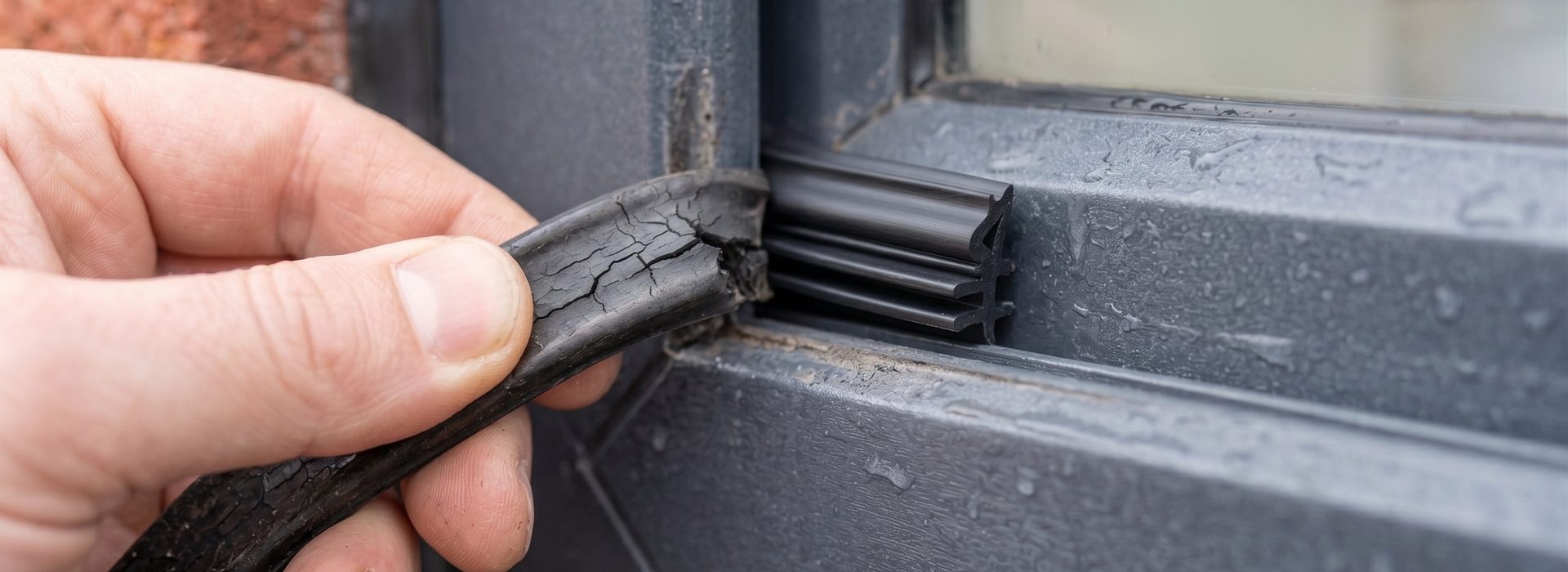
- Shrinkage - rubber shrinks with age and UV exposure, pulling away from corners and leaving visible gaps in the frame channel
- Loss of elasticity - a gasket that has hardened no longer compresses properly when the window closes; it sits stiffly in the channel without forming a seal
- UV degradation - direct sunlight causes the surface of rubber to become brittle and crack
- Deformation - in heavily used doors or frequently opened windows, gaskets can flatten permanently and lose their sealing ability
On 1990s to 2010s UPVC windows across Yorkshire, failing gaskets are extremely common. The original seals were installed 15 to 30 years ago and have reached the end of their service life.
Signs you need gasket replacement
- Cold draughts felt around the frame when windows or doors are fully latched - particularly in corners
- Condensation forming on the inner edge of the glass unit (distinct from condensation between the panes, which is a failed sealed unit)
- A rattling or vibrating window in wind, even when locked
- Visible gaps, shrinkage or cracking in the rubber seal around the frame
- Water ingress at frame corners in wind-driven rain despite no obvious sealant failure outside
The difference between gasket failure and sealant failure
This is where homeowners are frequently misled - and where incorrect diagnosis leads to unnecessary work.
External sealant is the flexible compound that fills the joint between the window or door frame and the surrounding brickwork. It is applied to the outside of the building, between two different materials.
Gaskets are internal to the frame system. They sit within the profile itself and compress when the opening is closed.
If you feel cold air around a frame in dry, still weather when the window is shut - that is almost certainly gasket failure. The draught is coming through the frame system, not through the gap between the frame and the wall.
If water appears predominantly during heavy rain and tracks down inside the reveal - the external perimeter sealant is more likely to be the cause.
Both can fail simultaneously, and both can be present on the same window. Correct diagnosis prevents you paying for one repair when you need the other - or missing one entirely.
See also: External sealant replacement | Draughts coming through doors and windows
Frame types and gasket systems
Different frame materials have different gasket arrangements.
UPVC frames typically use push-in or clip-in EPDM gasket profiles. These can usually be replaced without specialist tooling, but sourcing the correct profile for the frame system matters - there are hundreds of UPVC profile manufacturers.
Timber frames may use compression strip gaskets, foam seals or brush pile draught excluders, depending on the age and specification of the window.
Aluminium frames - more commonly found in commercial buildings and larger domestic properties - often use dual-durometer gaskets (a harder outer section and softer inner) designed specifically for that frame system.
Steel frames - found in heritage properties, Crittal-style windows and some mid-century commercial buildings - typically use a rubber or neoprene compression gasket seated in a channel around the frame rebate. On older steel windows, original gaskets may have hardened, cracked or shrunk away from the rebate entirely. Sourcing compatible replacements requires matching both the channel dimensions and the compression profile, as steel frame systems vary considerably between manufacturers and eras.
We assess the frame type and source compatible replacement seals before we start.
Our gasket replacement process
- Assessment - check the frame type, gasket condition and whether perimeter sealant is also involved
- Remove degraded gasket - carefully remove the existing seal from the channel without damaging the frame
- Clean the channel - remove debris and old adhesive from the groove to ensure the new seal seats correctly
- Install replacement seal - compatible gasket profile pressed or clipped into the channel along its full run, with corners correctly mitred or folded
- Check closure and compression - close the window or door and confirm the gasket is compressing correctly across its full length
- Advise on any related work - where external sealant also requires attention, we will identify this during the same visit
Where we carry out gasket replacement
We work across Leeds, Bradford, Harrogate, Ilkley, Wetherby and surrounding areas. Gasket replacement is particularly common on UPVC windows installed through the 1990s and 2000s - a generation of window stock that is now ageing across much of Yorkshire's domestic housing.
Not sure whether you need gaskets, sealant, or both?
A Building Leak & Damp Inspection will identify the cause before any work is carried out.
Restore proper compression and stop the draught.
Contact us to arrange a visit.