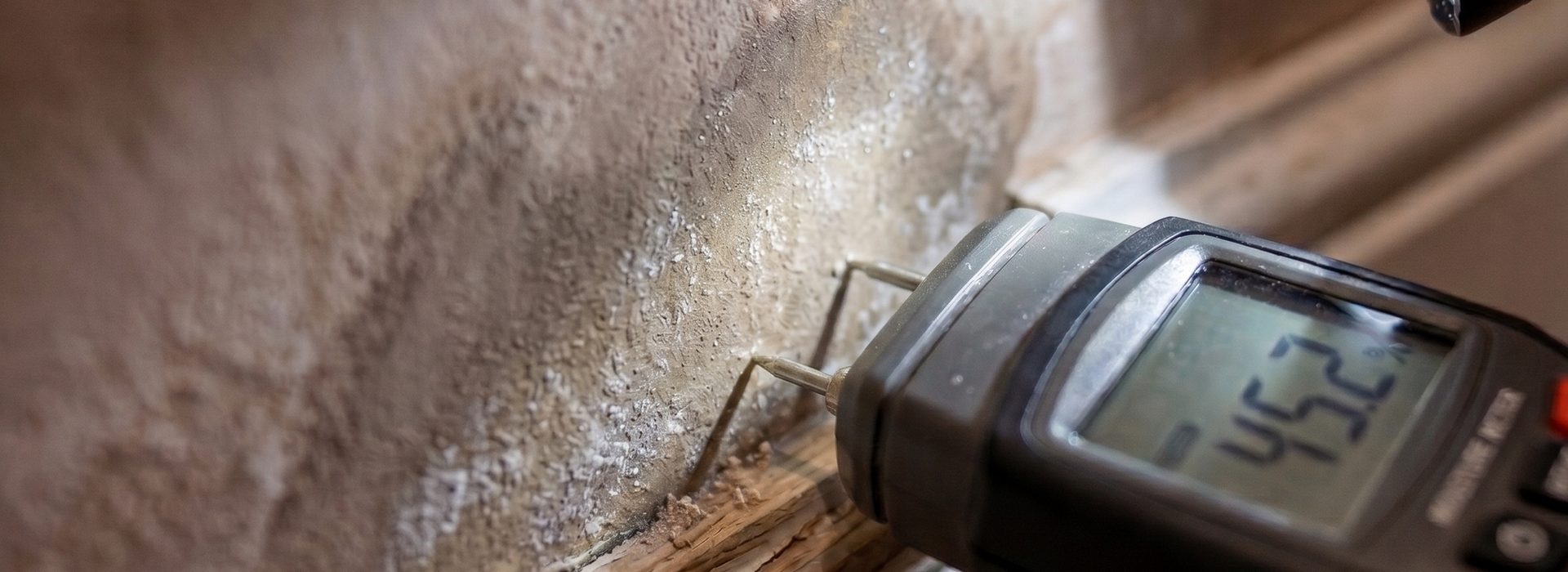
Building leak and damp inspection in Yorkshire - moisture meter reading on damp, salt-affected internal plaster to diagnose water ingress at source.

Specialist diagnosis

Building leak & damp inspection across Yorkshire

Water getting into a building is rarely self-explanatory. A damp patch on an internal wall might come from failed pointing five metres away. A persistent draught might mean a failed gasket rather than a gap in the external sealant. Treating the wrong thing - even correctly - solves nothing and delays the real repair.

NSJ position

We charge for diagnosis because guessing is expensive.

An inspection is for establishing the active cause of the reported defect before materials, repair scope or expenditure are prescribed. Without it, any repair is a proposal, not a solution.

Why diagnosis matters first

What a clear diagnosis can save you from

In most cases, you leave with a clear cause, a proportionate repair route and an honest answer if monitoring is more appropriate than immediate work.

Northern Seal & Joint carries out building leak and damp inspections to identify the actual source before any repair work is recommended or carried out.

Why accurate diagnosis matters

Most building defects we are called to repair have already been looked at by someone else. A previous contractor may have resealed the windows. A damp specialist may have recommended a course injection. Internal decoration may have been redone. And the problem is still there.

This happens because the symptom - a damp patch, a draught, a stain after rain - is easy to see, but the cause requires methodical examination of the building fabric to identify properly.

Carrying out the wrong repair means:

  • Spending money that does not fix the problem
  • Potentially delaying and worsening the underlying defect
  • Creating new problems where treatments were unnecessary

An inspection separates diagnosis from repair. It establishes what is actually happening before a single material is purchased or applied.

What we look for

Our inspections focus on the causes of water ingress, air infiltration, damp and related building fabric failure.

We regularly identify:

  • Failed or missing mortar joints allowing rainwater to penetrate brick or stone walls
  • Deteriorated external sealant around windows, doors and perimeter joints
  • Failed window or door gaskets causing draughts or water ingress at the frame
  • Brickwork or stonework absorbing excessive water through the face
  • Cracked, spalled or damaged masonry providing a direct route for water
  • Incorrect previous repairs - cement mortar on lime-built properties, sealed-over failed sealant, non-breathable coatings trapping moisture
  • Patio and external paving joints allowing water to penetrate to the bedding layer, building base or rooms below

We also look at the surrounding building fabric, not just the apparent defect point. In many cases, water travels some distance from where it enters to where it appears.

You can explore the issues we most commonly investigate on the Problems We Fix section.

Our three-tier inspection system

We offer a structured inspection approach matched to the complexity of the problem.

Tier 1 - Leak Triage Inspection

A focused visit for situations where the likely source is already apparent from the outside.

Typically used for:

  • Water appearing around a specific window or door
  • Cracked or missing mortar in a visible, accessible location
  • Patio joints that have clearly failed
  • A gap around a frame that can be seen from ground level

During this inspection, we examine the affected area and the surrounding building fabric to identify entry points and confirm the cause. We will advise on the appropriate repair and provide a clear recommendation. For straightforward situations, a Tier 1 inspection may lead directly into repair work on the same visit or shortly after.

Likely repairs: External sealant replacement | Cement mortar repointing | Window and door gasket replacement | Patio pointing and repair

Tier 2 - Diagnostic Building Inspection

A more detailed inspection used when the cause is not immediately obvious or when previous repairs have not resolved the problem.

  • Internal damp patches that appear after heavy rain but have no obvious external source
  • Brickwork that saturates quickly and takes days to dry
  • Leaks that have persisted despite earlier repair attempts
  • Multiple potential causes that need to be systematically ruled out

This inspection examines a wider area of the building fabric:

  • Condition of mortar joints across the affected elevation
  • Window and door seals and perimeter joints
  • Masonry surface condition and absorption characteristics
  • Any routes where water may be travelling before it appears internally

A written inspection report is available where required - this may be useful for insurance purposes, for landlords, or where a formal record of condition is needed.

Likely repairs: Lime mortar repointing | Masonry repair | Breathable water-repellent treatment

Tier 3 - Access or Multi-Area Inspection

Used where the building requires inspection at height, across multiple elevations, or involves a larger or more complex property.

  • Larger detached properties where multiple elevations need examining
  • Apartment buildings with shared fabric
  • Commercial properties
  • Higher-level masonry defects where the affected area is not accessible from ground level

This tier may require access equipment - typically a MEWP, drone or other high-level platform - to inspect joints, sealant and masonry condition at the affected height. We will advise on access requirements as part of the initial contact.

Before and after inspection

Before the inspection, it is useful to note:

  • When the problem appears (during rainfall, after rainfall, in cold weather, all the time)
  • How long it has been present
  • Any previous repair work that has been attempted
  • Any internal symptoms (damp patches, staining, mould, draughts)

This context helps us prioritise where to start looking.

After the inspection, you will receive a clear verbal recommendation - and a written report where requested - setting out what we found, what is causing the problem, and what repair approach we recommend. We will not recommend work that is not needed. If the situation warrants monitoring rather than immediate repair, we will say so.

Northern Seal & Joint carries out building leak and damp inspections across Bradford, Leeds, Harrogate, Ilkley, Otley, Skipton, Wetherby, Halifax and the surrounding Yorkshire area.

See the Areas We Cover page for full detail on where we work.

Before and after examples of repointing, sealant replacement and masonry repairs are shown in Our Work.

Reviews from recent projects are on the Reviews page. ​

Find the cause. Fix it once.

If you are dealing with persistent damp, a leak that keeps returning, or simply do not know where water is getting in, an inspection is the right starting point.

Book an inspection or contact us to discuss the issue you are experiencing.

Common causes of damp we find in Yorkshire properties

Yorkshire's housing stock — predominantly Victorian and Edwardian solid-wall construction in stone and brick — has specific vulnerability patterns that we see repeatedly.

Failed or incorrect repointing

The most common cause of water ingress in older Yorkshire properties. Either the mortar joints have deteriorated to the point where they no longer exclude water, or a previous contractor has used cement mortar on a lime-built wall — creating a hard, impermeable joint that forces moisture into the surrounding masonry rather than allowing it to escape. Both conditions allow water in; the cement case also traps it, making the problem worse over time.

Failed external sealant

Sealant around windows and doors degrades over time — it cracks, pulls away from the frame, or hardens and loses adhesion. Once the seal fails, water tracks behind the frame and appears internally, sometimes some distance from the actual entry point. External sealant failure is one of the most commonly missed causes of internal damp.

Porous or absorbing masonry

Untreated gritstone and sandstone — the dominant masonry types across Bradford, Harrogate and Ilkley — can absorb significant quantities of water in heavy or sustained rainfall. In mild cases, the wall saturates during rain and dries between showers without causing internal problems. Where the wall is thick enough and the drying is quick enough, this is the building working as intended. Where it is not — particularly in north-facing or sheltered positions — the saturation cycles accumulate and begin to penetrate.

Chimney and parapet defects

Chimney stacks and parapets are among the most exposed masonry on any building, and among the last to be maintained. Failed chimney haunching, deteriorated flaunching, open mortar joints and cracked lead flashings all allow water to enter at height — from where it tracks down internally and appears far from the source. High-level defects are among the hardest to self-diagnose from ground level.

Gasket and frame failure

Modern and mid-twentieth century double-glazed units have rubber gaskets that seal the glass into the frame. When these fail, draughts and water infiltration follow. This is often mistaken for sealant failure or condensation. The distinction matters — a failed gasket requires replacement; a failed sealant joint requires resealing.

What happens after a damp inspection

We will tell you clearly what we found, what is causing it, and what repair is needed. Where the problem is straightforward, we can move directly to a repair quotation on the same visit.

Where a written report is required — for insurance purposes, for landlord records, or for a pre-purchase survey — this is available on request for Tier 2 and Tier 3 inspections.

We do not carry out unnecessary work. If we inspect and find the problem does not require immediate intervention, we will say so and advise on monitoring or timescale.

Damp inspection vs damp proofing companies

Damp proofing companies — those specialising in injection DPC, tanking membranes and chemical treatments — have a commercial interest in recommending their products. The treatments they provide are appropriate for certain types of damp (rising damp in particular), but are frequently misapplied to buildings where the actual problem is water ingress from above, not below.

An inspection by a contractor who diagnoses before selling a remedy gives you an independent assessment of what is actually happening. We identify causes and recommend repairs — we do not sell damp proofing products.

Common questions

Frequently asked

Do I have to have an inspection before a repair?

Not always. If the cause is clear - a visibly cracked joint, sealant that has pulled away from a frame - we can often move straight to repair. An inspection is most valuable where the cause is uncertain or where previous repairs have not worked.

Do you charge for inspections?

Get in touch and we will discuss the appropriate tier for your situation and advise on whether a chargeable inspection visit is the right first step, or whether the issue can be assessed and quoted at the same time as a repair visit.

Can you provide a written report?

Yes. A written inspection report is available on request, particularly for Tier 2 and Tier 3 inspections. This may be useful where a formal record of building condition is needed.

Will the inspection tell me exactly what needs repairing?

In most cases, yes. Occasionally a problem requires further investigation - for example, where the source of water is at significant height and cannot be examined without access equipment. In that case, we will be clear about what we found and what additional steps are needed.

Do you carry out the repairs after inspection?

Yes. If we inspect and identify the cause, we will provide a recommendation and quote for the appropriate repair. There is no obligation to proceed.

What is the difference between rising damp and penetrating damp?

Rising damp is groundwater moving upward through porous masonry by capillary action — it appears as a tide mark typically no higher than 1–1.5m from floor level and is associated with salts drawn up from the ground. Penetrating damp is water entering from outside — through failed pointing, sealant, masonry or roof defects — and can appear anywhere on an internal wall or ceiling, usually in a pattern that relates to rainfall or wind direction. The two causes require completely different remedies. Penetrating damp is significantly more common in Yorkshire's older housing stock.

Do you inspect roofs and chimneys?

We inspect chimneys and high-level masonry as part of Tier 2 and Tier 3 inspections where the source of water is suspected to be at height. For chimney repointing, flaunching or lead flashing defects, we will identify the problem and recommend the appropriate repair. We do not carry out general roof repairs — our specialist area is masonry, pointing, sealant and building fabric at and below ridge level.

How long does a damp inspection take?

A Tier 1 triage inspection on a single elevation or specific area typically takes 30–60 minutes. A Tier 2 diagnostic inspection covering multiple elevations and internal symptoms usually takes 1–2 hours. Tier 3 inspections involving access equipment or multiple areas of a larger property take longer — we will advise on time when the scope is established. In all cases, you receive a clear verbal recommendation at the end of the visit.

Can you inspect before I buy a property?

Yes. A pre-purchase inspection is one of the most effective uses of a specialist inspection. If a survey has flagged potential damp, water ingress or masonry defects, we can visit the property, identify the cause and give you a realistic picture of the repair scope and cost before exchange. This is more useful than a general surveyor's flag of "damp present — recommend specialist investigation" with no further detail.

Next step

Get a clear answer first

Specialist diagnosis with a written report. We tell you what is causing the problem and what the correct repair route is.

Get in touch Leak & damp inspection

Talk to a specialist

Get it diagnosed properly.

Specialist contractor covering Bradford, Leeds, Harrogate, Ilkley, Otley, Skipton, Wetherby, Halifax, Saltaire and surrounding Yorkshire areas.

Request a quote
WhatsApp us
or call 07892 854738